
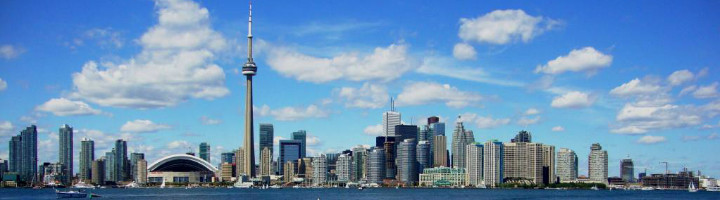
NIAGARA FALLS
Niagara Falls is the collective name for three waterfalls that straddle the international border between the Canadian province of Ontario and the U.S. state of New York. From largest to smallest, the three waterfalls are the Horseshoe Falls, the American Falls and the Bridal Veil Falls. The Horseshoe Falls lie on the Canadian side and the American Falls on the American side, separated by Goat Island. The smaller Bridal Veil Falls are also located on the American side, separated from the other waterfalls by Luna Island. The international boundary line was originally drawn through Horseshoe Falls in 1819, but the boundary has long been in dispute due to natural erosion and construction.
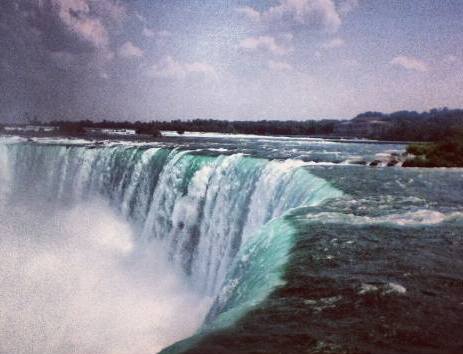
Located on the Niagara River, which drains Lake Erie into Lake Ontario, the combined falls form the highest flow rate of any waterfall in the world, with a vertical drop of more than 165 feet (50 m). Horseshoe Falls is the most powerful waterfall in North America, as measured by vertical height and also by flow rate. The falls are located 17 miles (27 km) north-northwest of Buffalo, New York and 75 miles (121 km) south-southeast of Toronto, between the twin cities of Niagara Falls, Ontario, and Niagara Falls, New York.
Niagara Falls were formed when glaciers receded at the end of the Wisconsin glaciation (the last ice age), and water from the newly formed Great Lakes carved a path through the Niagara Escarpment en route to the Atlantic Ocean. While not exceptionally high, the Niagara Falls are very wide. More than 6 million cubic feet (168,000 m3) of water falls over the crest line every minute in high flow, and almost 4 million cubic feet (110,000 m3) on average. The larger Horseshoe Falls are about 2,600 feet (790 m) wide, while the American Falls are 1,060 feet (320 m) wide. The distance between the American extremity of the Niagara Falls and the Canadian extremity is 3,409 feet (1,039 m).
The Niagara Falls are renowned both for their beauty and as a valuable source of hydroelectric power. Managing the balance between recreational, commercial, and industrial uses has been a challenge for the stewards of the falls since the 19th century. The verdant green colour of the water flowing over the Niagara Falls is a by-product of the estimated 60 tonnes/minute of dissolved salts and "rock flour" (very finely ground rock) generated by the erosive force of the Niagara River itself. The current rate of erosion is approximately 1 foot (0.30 m) per year down from a historical average of 3 feet (0.91 m) per year. However, it is estimated that 50,000 years from now, even at this reduced rate of erosion, the remaining 20 miles (32 km) to Lake Erie will have been undermined and the falls will cease to exist.
City of Niagara Falls: https://www.niagarafalls.ca/
Transport from Toronto: There are more possibilities how to get to Niagara Falls from Downtown Toronto. One of the cheapest, fastest and convenient is to use GOTransit (Train, Bus) with very reasonable prices (one way around CAD 20). More info bout go transit you can find here.